Hardware
Boards designed to be built, not just to work once
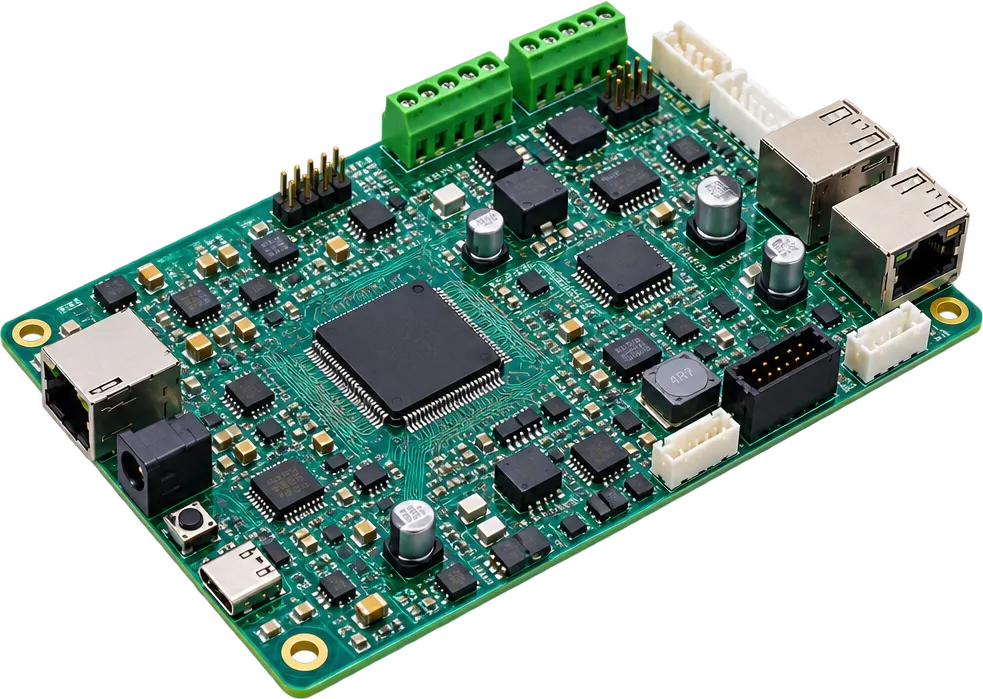
A prototype that functions on the bench is the easy half. We design for the version that has to be manufactured repeatably, pass compliance, and still be buildable.
Capability
Five disciplines, one team
Held together rather than subcontracted apart, so a layout constraint can change a component choice the same afternoon.
01
Architecture and concept development
Feasibility, topology and the hardware/software partition. Power budget, thermal envelope and interface selection settled early, because these are the decisions that are expensive to revisit after layout.
02
Schematic design
Analog, digital, high-speed and mixed-signal design. Clock trees, DDR and serial interfaces treated as signal-integrity problems from the outset rather than after the first prototype fails to enumerate.
03
PCB design
Multilayer stackup definition, controlled-impedance routing, power distribution and EMC-aware placement. Layout is done with the compliance test in mind, not as a formality afterwards.
04
Component engineering
Part selection weighed against availability, lifecycle, second sourcing and cost at your projected volume. A BOM that cannot be bought quickly is not a finished design.
05
Prototyping and manufacturing
Fabrication and assembly managed end to end, then bring-up and characterisation against the specification. Design-for-manufacture feedback folded back into the design before volume.
Platforms
What we design around
Silicon
- STM32 series
- Nordic BLE SoCs (nRF52, nRF53, nRF54)
- Microcontrollers (MCUs)
- Microprocessors (MPUs)
- Custom SoCs
- FPGA integration
Signal domains
- Digital design
- High-speed interfaces
- Mixed-signal
- Power management
Interfaces and connectivity
- Ethernet
- RS-232 / RS-485
- SPI / I²C
- microSD and Flash
- Wi-Fi
- BLE
- LoRa
- GPS
- LTE-M / NB-IoT
- Custom devices
Evidence
Hardware we have delivered
Projects that exercised most of the above.
Turn-key IoT platform for trackside monitoring and data logging
Eight-channel analog acquisition, optically isolated safety monitoring and a custom LoRa-to-Linux bridge on a single 110V AC board.
Connected LED signal marker board for railway applications
Redundant LED strings that degrade rather than go dark, with carrier-independent LTE-M/NB-IoT, GNSS tracking and over-the-air updates on a battery budget.
Turn-key design of a precision 56 kHz loop signal generator
Three signalling frequencies held to ±0.01% with sub-5ms switching, dual waveform output, and a 50Ω output stage driven from 24V DC.
Next
Hardware is half the product
The board is only as good as the firmware that brings it up. We write that too — which is why our bring-up phase tends to be short.
Tell us what you are building
Send us a specification, a block diagram, or a rough idea. We will come back with an honest assessment of scope, risk and the fastest route to a working prototype.